Stevie Wonde4 Could Have Seen Again
'A ll right, mate?" chirrups Stevie Wonder in a mockney accent concluding tried past Dick Van Dyke. He is tired, hardly surprising given it is 2.30am where he lives in California, but that doesn't terminate him from acting his usual playful self. Nor does it forbid him from talking at length near his 50-year career, and the events that shaped it.
He's non one to hold back. Before long, he is vividly remembering the car crash in which he nearly lost his life. It was 1973, and the sedan in which he was travelling careened into a truck. His wounds were severe.
"It was on 6 Baronial that I almost died in that car blow," he recalls. It was a key date for another reason. "It was too on 6 August – 1988 – that my son Kwame was born. Life is funny."
Does the crash remain the signal event of his life?
"Information technology is significant," he replies, and information technology'southward a typical Wonder response, "but I was blessed to come out of it. God gave me life to keep to do things that I would never accept done."
Primary among these was the electrification of modern soul that he effected on his boggling series of 70s albums. They have exerted a tremendous influence on musicians, from Michael Jackson and Prince in the 80s to rapper Drake and this year's most lauded new R&B star, Frank Sea.
"Yeah, I like Frank," says Wonder, who sang the hook from Sea's No Church building In The Wild to the Odd Future awareness when he met him at a political party recently. The feeling is mutual: reviews of Bounding main'southward 2012 album, Channel Orange, drew comparisons with Wonder's music at its nearly expansive.
After being consigned to MOR-soul hell following the likes of I Just Called To Say I Loved You, Wonder – who adjacent week headlines Bestival – is hip again. Is there anybody who doesn't like him?
"Heh," he chuckles, then pauses. "Well, there are those. But nosotros don't like to call up about that."
No, Wonder-haters are few. Maybe he'southward thinking of his early on days. In Where Did Our Love Go?, a history of Motown, Nelson George noted the jealousy amidst staffers towards the 12-year-old-genius, fifty-fifty if detractors were shortly silenced by his fabulous run of mainly self-penned hits: Uptight (Everything'southward Alright), For Once In My Life, My Cherie Amour and Signed, Sealed, Delivered.

In 1971, he released the transitional Where I'm Coming From, which along with Marvin Gaye's What's Going On was the first serious album from a label accustomed to singles. It was a brave departure from the Motown sound, with forays into psychedelia, baroque pop and folk-inflected soul.
"I had fun doing that album with [ex-married woman] Syreeta," he says. "Berry [Gordy, Motown boss] said: 'Do your thing.'"
He recalls writing the song If You Actually Dear Me at the flat of Laura Nyro, no stranger herself to the startling chord sequence. Fellow Motown songwriter Smokey Robinson, nonetheless, was unimpressed with his new direction later on he saw Wonder on comedian Flip Wilson'due south Boob tube testify.
"I got a call from Smokey and he says: 'I didn't like your choice of material. I recollect it's really ridiculous.' I said: 'I don't give a "uh" what you lot recall, or what anyone thinks!' That was my growing-up moment at Motown."
Hooking upward with Malcolm Cecil and Robert Margouleff of electronic duo Tonto'south Expanding Headband, Wonder pursued a radical synthesised context for his new soul vision. His purple streak continued with 1972'south Music of My Heed and Talking Book, 1973's Innervisions, 1974's Fulfillingness' Kickoff Finale, culminating in 1976's double-LP (plus additional EP) treasure trove Songs In The Key Of Life. With their dazzling melodies and blend of gritty politicised funk and elegant ballads, these albums appealed to rock and soul fans akin.
He overreached himself on 1979's Journey Through The Underground Life Of Plants, a double concept album total of new age noodling, but he redeemed himself, critically and commercially, with 1980's Hotter Than July. And if his recordings since accept been patchily received, there is consensus among music lovers that his golden age lasted longer than anyone's, Bob Dylan and the Beatles included.
Wonder is adamant that his heyday of exploratory music-making is not over, despite the fact that his final anthology, A Time to Love,simply his 4th LP proper in three decades, was issued in 2005. "I'chiliad still experimenting," he enthuses. "In that location's a new musical instrument I'm learning to play called the harpejji. It's between a piano and a guitar. I'm writing actually different songs with it – I have so many. The question is, volition they outlive me? Fourth dimension is long but life is short."
Does Wonder, who has simply turned 62, have a growing sense of his mortality? "I don't feel information technology," he says of time'due south marching. "I know it for a fact."
He feels a pressing need to attain in not-musical spheres, and digresses to talk over gun offense, a subject field on which he has been outspoken. "I'm concerned about how accessible guns are," he says. Is he referring to the "Batman shootings" in Colorado?
"No, I'one thousand talking about in the hood," he replies. "That [Colorado] was also very sad, but this is an occurrence almost every week in various cities. But no politician wants to confront it. The correct to bear arms? What near the right to live?"
Does he fear what happened to John Lennon could happen to him?
"I've had threats," he says, "only I don't put that energy out there because that's simply craziness."
Tin can he feel the same connection to "the street" that he did in the 70s when he penned sociopolitical anthems such every bit Living For The Metropolis?
"Of course," he exclaims. "I travel and do stuff."
What's information technology similar when he and his entourage sweep through town?
"I just focus on what I'm doing," he says. "If fans take pictures ... Every time I call back virtually getting annoyed I recall how blessed I've been to have people who take followed my career."
Is he in touch with the young man who wrote, say, Superstition?
"Oh yes," he replies, breezily. "I listen to him. And I make sure I feel the same fashion still."
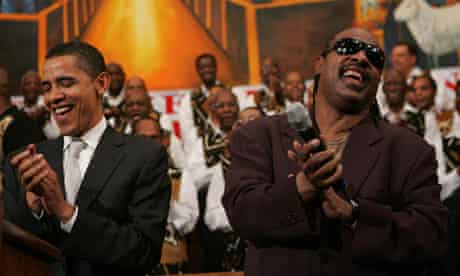
Many of his best-loved songs were Nixon-era rebukes. These days, he supports the president. What is his view of rappers such as Jay-Z, said to be turning against "B-Rock"?
"Well," he sighs, striking a rare annotation of antipathy, "those who have turned against him, it's because they're ignorant or it doesn't serve their own involvement, which probably has to do with money. But the reality is, your money is only equally proficient every bit you're able to aid others with it."
Even before his accident, when his music was at its near supersonically joyous, Wonder spoke in dread tones of an apocalyptic future, and of the ominous present presaging it. "It's the last days of life, of beauty," he declared, referring darkly to "all the horrors and hypocrisy in the world".
After the crash he became increasingly affirmative. But how practice these times compare? Is he more optimistic at present?
"I'm e'er optimistic, but the globe isn't. People demand to make a jump to a identify of positivity simply they put it all on ane person to make it happen," he says. "It takes everybody. And the mindset has to be different. I mean, how practise nosotros accept, in 2012, racism in the globe?"
Did he assume that racism would be obliterated?
"Information technology tin can't exist obliterated until people confront the demon in the spirit," he says. No wonder one of his current roles is equally a Messenger of Peace for the United nations.
"You need to put your center into making a difference," he says, proposing "an finish to poverty, starvation, racism and illiteracy and finding cures for cancer and Aids" every bit simply some of the jobs that need doing.
Doesn't he wish he could subvert his beatific image? Has the Messenger of Peace e'er wanted to dial someone?
"No," he says patiently, as though to a child who has said something especially dumb. "When you dial somebody information technology means you have let your ability to communicate out the gate."
Wonder mentions "the demon in the spirit". How has he managed to endure when his revolutionary soul peers – Marvin, Sly Stone, James Brown – succumbed to torment and temptation?
"First of all," he stresses, "I'm no better than the side by side person. But I've never had a want to exercise drugs. When I was 21 I smoked marijuana, and I didn't like the way it made me experience. When I woke up the next morning I felt like I'd lost part of my encephalon."
Wonder has also seen the passing of younger talents: Michael Jackson, Whitney Houston, Amy Winehouse ...
"It'south been a heartbreak," he says. "Manifestly I knew Michael." In 2009 he bankrupt down during a performance of Jackson's The Fashion You Brand Me Feel. "I knew Whitney, too, and I understand Amy came to my concert in England a couple of years agone. I was thinking near us doing a duet – an onetime Marvin and Mary Wells vocal chosen Once Upon A Time. Information technology would accept been astonishing."
Had he met Winehouse, would he have offered her words of wisdom, or would in that location have been no point?
"There'due south always a point," he says.
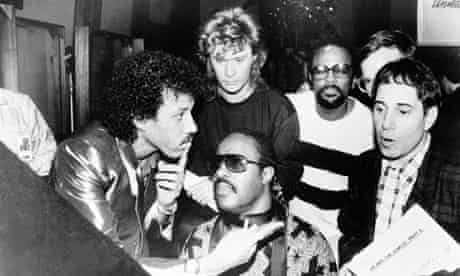
Wonder has never gone off the rail, although when I ask whether a picture show version of his life would be a drama, a comedy or a tragedy, he says: "All of the in a higher place." Does he ever consider that it's his "disadvantages" – being born blind and blackness – that accept fabricated him what he is?
"Exercise you lot know, it's funny," he starts, "only I never thought of existence blind as a disadvantage, and I never thought of being black as a disadvantage. I am what I am. I love me! And I don't mean that egotistically – I love that God has allowed me to take whatever it was that I had and to brand something out of it."
Does he never allow himself an egotistical moment to survey his career?
"Nah," he says, "that'southward a waste of time. I savour listening to the stuff I've done, simply that's information technology."
Is he a genius?
"No," he says, "I was simply blessed to have ideas. The genius in me is God – information technology's the God in me coming out."
This summertime, he met the Queen afterward performing at the jubilee concert in London.
"She was born under the same astrological sign as me: Taurus," he marvels. "It was wonderful meeting her."
When I suggest that, if anyone should have been bowing and scraping, it was the one who, past blow of birth, caused enormous status and wealth, not the one who, by sheer difficult graft, changed the course of popular culture, he disagrees.
"That's because you don't believe in the power and the spirit that is intangible but is all around us," he mildly scolds. "There has to be a higher energy power."
Nevertheless, Wonder is aware of his impact, and of those who accept picked upwards his progressive soul baton, such as Bounding main. Was he surprised that at that place could, in 2012, be a furore at the revelation that a rapper might be gay?
"I think honestly, some people who recall they're gay, they're confused," he says. "People can distort closeness for love. People tin can feel connected, they bail. I'm not saying all [gay people are confused]. Some people take a want to be with the same sex. Merely that'south them."
In 1974, US rock critic Robert Christgau described Wonder every bit "a sainted fool". He wrote: "I'yard not saying he's a complete fool; in fact, I'm non maxim he isn't a genius. But you can't deny that if y'all were to turn on a telephone-in station and hear Stevie rapping near divine vibrations and universal alliance ... you would not be impressed with his intellectual discernment." Certainly, with Wonder, yous have to append your cynicism. But he has to contend with being narrowcast nevertheless.
"I've never said I was a soul artist or an R&B artist," he responds when I venture that the music he made in the 70s was a soul version of progressive rock. "They're just labels. When you're soul it means black, when you're pop it means white. That'due south bullshit. If information technology'due south good, it's good. It'south similar that old Jerry Reed song: 'When you're hot, you're hot, when you're not, you lot're non.'"
Source: https://www.theguardian.com/music/2012/aug/30/stevie-wonder-blind-black-disadvantage
0 Response to "Stevie Wonde4 Could Have Seen Again"
Post a Comment